A walking pad sounds like a practical solution: staying active while you work without having to go to the gym. But for many remote workers and apartment dwellers, a practical question quickly arises: how much noise does such a device actually make? Will your downstairs neighbor complain? Can you hear it through your headset during a meeting? The good news is that modern walking pads are considerably quieter than traditional treadmills. But "quiet" is relative, and there are several factors that determine how much noise your walking pad makes. In this article, we explain what affects the noise level, what you can reasonably expect, and how you can further reduce the noise.
What is a realistic noise level?
Most walking pads produce a noise level of 55 to 75 decibels during normal use. For comparison: a normal conversation is around 60 dB, and a vacuum cleaner is around 75 dB. A walking pad at a low speed (2–4 km/h) therefore sounds roughly like background noise in a busy office—audible, but not disruptive.
Which factors affect the noise?
The noise level of a walking pad is not a fixed value. Several factors play a role.
1. Motor power
A powerful motor does not necessarily have to be louder, but a cheap motor with high power often runs more unevenly and produces more mechanical noise. High-quality walking pads use a well-tuned motor that runs smoothly and quietly, even during prolonged use.
2. Walking speed
The faster you walk, the more noise the device makes. At walking speeds of 2 to 4 km/h, a walking pad is barely audible. As soon as you increase the speed to 6 km/h or higher, the noise level increases noticeably, both from the motor and from your own footsteps on the belt.
3. The surface the device is placed on
This is a factor that many people underestimate. A walking pad on a hard wooden floor or tiles amplifies vibrations enormously. On a carpet or a protective mat, the same device is considerably quieter. The floor literally acts as a soundbox if you do not take this into account.
4. Cushioning and quality of the treadmill
Cheaper models have little to no cushioning under the treadmill belt. Every step lands hard on the frame and creates a clattering sound. More expensive walking pads, such as those from Dreaver, feature multiple layers of cushioning that absorb the impact and significantly reduce walking noise.
5. Maintenance
A walking pad that is not or barely lubricated makes more noise. A dry treadmill "squeaks" with every rotation. Regular maintenance not only keeps the device in good condition longer but also ensures quieter operation.
Can a walking pad be heard through the floor?
This is the key question for apartment dwellers. And the honest answer: it depends.
On the first floor or higher, vibrations do travel through the floor, but sound through the air much less so. What your downstairs neighbor hears is not so much the motor noise, but the mechanical vibrations of the running device. That is exactly why a good anti-vibration mat is so effective: it catches the vibrations before they reach the floor.
At walking speed (what most people do on a walking pad), the vibrations are minimal and comparable to those of someone simply walking around an apartment. In most cases, this is not a problem.
Practical tips to reduce noise
You do not have to leave it at the default settings. With a few simple adjustments, you can make your walking pad noticeably quieter.
Use a protective mat or anti-vibration mat
This is by far the most effective measure. A thick rubber mat under the device dampens vibrations while also protecting your floor. Mats specially developed for treadmills are ideal, but a sturdy yoga mat or exercise mat also works well.
Choose a lower speed
At 2–3 km/h, a walking pad is barely audible above background noise in most cases. Save higher speeds for times when noise is less of a problem.
Place the device on a sturdy, level surface
A tilted or wobbly device always makes more noise. Check that the walking pad is stable and adjust the feet if necessary.
Maintain the device regularly
Lubricate the treadmill belt at the recommended intervals and check for loose parts that could rattle. A well-maintained walking pad is noticeably quieter than a neglected one.
Wear suitable shoes
Bare feet or thin socks create more impact noise than a pair of lightweight sports shoes with cushioning. That may sound like a minor detail, but the difference is clearly audible.
When is a walking pad too loud?
There are situations in which even a quiet walking pad is not ideal. Think of:
Video calls without a headset: the motor noise can be picked up by your microphone, especially with cheaper models.
Late evenings in an apartment complex: even a quiet device can be perceived as disruptive when the rest of the building is quiet.
Older or cheaper walking pads: models without good cushioning or with an outdated motor are simply louder.
In those cases, it is wise to choose a walking pad specifically designed for home use, with extra attention to sound insulation and cushioning technology.
What makes a walking pad suitable for home use?
A walking pad for home use must meet a few specific requirements. In addition to a low noise level, these are: a compact design, a safe speed limit, and a motor that runs stably and quietly even during prolonged use.
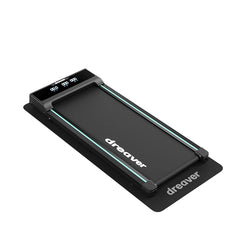
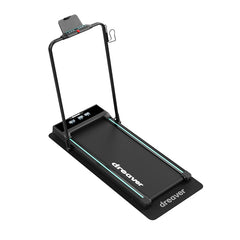
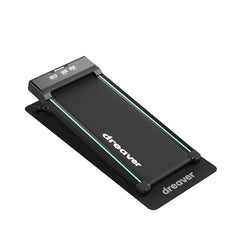
Dreaver treadmills are designed with the home user in mind. The cushioning layers under the walking surface of the Dreaver Motion One, the quiet motor drive, and the stable construction ensure that you can walk quietly without turning your home or apartment into a gym.
Noise level: not a dealbreaker
The question is not whether a walking pad makes noise, but how much. And in practice, for most people, it is really not a big deal. At normal walking speeds, on a suitable surface and with a quality device, a walking pad can be easily integrated into a home office environment.
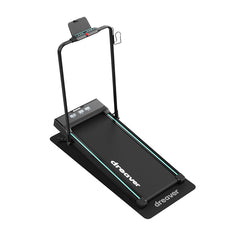
Taking the step toward more movement during the workday does not have to come with noise pollution. With the right choices, the Dreaver Motion Pro is a quiet and effective addition to the home office. For those who need extra support and a sense of safety while walking, the Dreaver Assist One offers the necessary stability at a low noise level.
Curious which treadmill best suits your situation? For those looking for extra intensity with an incline function, the Dreaver Elevate One or the Dreaver Climb One are good options. For the most demanding user who chooses a powerful motor and maximum cushioning, the Dreaver Elevate Pro is the most suitable model for the floor, space, and usage pattern. View the full range and discover the possibilities.