Running has long been known as the best way to burn calories. You put on your sneakers, run a few kilometers, and voilà—the fat disappears on its own, right? But is that really true? More and more research shows that walking can be at least as effective for weight loss, and for many people, it even works better in the long term. Not because walking is "easier" in the sense of being inferior, but because it is a form of exercise you can actually stick with. No injuries, no recovery periods, no mandatory rest days. Just moving, day after day. In this article, we explain how walking and running compare in terms of fat burning, injury risk, and consistency. And we show you how a walking pad or treadmill at home can help you effortlessly get more steps in each day without having to completely turn your schedule upside down.
Burning calories: running wins on paper, but...
At first glance, running wins the duel. A 75 kg person burns about 350 calories in half an hour of running (at a pace of 9 km/h). That same person burns about 190 calories in half an hour of brisk walking (at a pace of 6 km/h).
That seems like a big difference, but the comparison doesn't stop with that single workout.
Running is intense. Your body needs time to recover, your muscles get tired, and the risk of overuse increases. Many people, especially beginners or those who are overweight, simply cannot run every day. Walking, however, is manageable. And if you walk for an hour every day instead of running for half an hour three times a week, the balance quickly tips.
The role of NEAT in energy expenditure
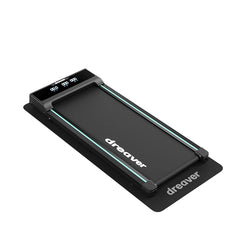
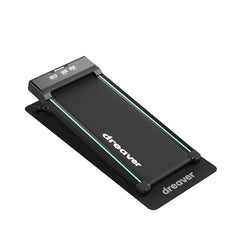
In addition to planned exercise, NEAT also plays a major role: Non-Exercise Activity Thermogenesis, or all the calories you burn outside of formal exercise. Walking fits well into this principle. A walking pad like the Dreaver Motion One under the desk, a walk after dinner, or a few extra steps during the day: all that movement counts. Running often happens in blocks, while walking can continue throughout the day.
Stress on joints and injury risk
This may be the biggest practical difference between the two activities.
When running, your body absorbs a shock of two to three times your body weight with every step. Your knees, hips, and ankles have to absorb that over and over again. An estimated 50% of all runners suffer at least one injury per year. Knee pain, shin splints, stress fractures: these are well-known ailments in the running world.
Walking puts significantly less stress on your joints. The shock with each step is only one and a half times your body weight. This makes walking more accessible to people who are overweight, older adults, or anyone who experiences recovery issues. Fewer injuries mean fewer interruptions, and fewer interruptions mean more consistency.
Consistency is the key to weight loss
The best form of exercise is the one you stick with. That sounds logical, but it is too often overlooked.
Weight loss is not about the right workout. It is about a consistent calorie deficit over a longer period. A walking program you can stick with 365 days a year will do more for your weight than an intense running plan you drop after six weeks due to fatigue or injury.
Walking has a low barrier to entry. You don't need to be in special shape to start, you can do it at your own pace, and it doesn't feel like a strenuous workout. This makes it mentally much easier to stick with, even on busy days.
Walking at home: how it works in practice
The biggest obstacle to moving more is often simply time and motivation. It is raining, your schedule is full, or you are too tired to go outside. These are the moments when a walking pad or treadmill at home really makes a difference.
Walking pad: moving while you work
The Dreaver Motion Pro is a compact treadmill without handrails, designed for use behind a desk or at a standing desk. You can walk at a leisurely pace while you work, attend a meeting, or watch a series.
Suppose you walk on a walking pad for two hours of work each day at a pace of 4 km/h. That is 8,000 extra steps per day, or more than 5 km. For someone who weighs 75 kg, that can quickly add up to 250 to 300 extra calories per day, without feeling like exercise.
Treadmill: structured workouts at home
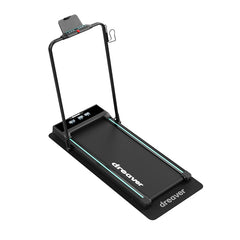
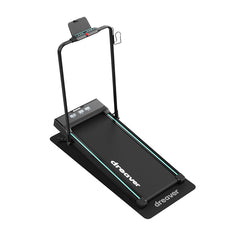
A traditional treadmill offers more options for those who also want to walk or jog actively. You can set the speed and incline, allowing you to adjust the intensity to your goal. Walking on an incline significantly increases energy expenditure. With the Dreaver Elevate One or the Dreaver Climb One, this effect can be comparable to running on flat ground, while the stress on the joints remains limited.
Practical tips to get more steps in
Want to get the most out of your walking pad or treadmill? Then use these tips:
Link walking to something you already do. Working from home? Turn on the walking pad during meetings or while going through emails. Watching a show in the evening? Step onto the treadmill.
Increase the incline. Walking on an incline of 5% or more burns considerably more calories without raising your heart rate too much. This is a smart way to increase intensity without having to run.
Set a daily step goal. Start with 8,000 steps per day and gradually build up to 10,000 or more. Many treadmills and walking pads work with your phone or smartwatch to track this.
Alternate speeds. By alternating three minutes of brisk walking with one minute at a normal pace on the Dreaver Elevate Pro, you increase the average energy expenditure without excessive exertion.
Make it a ritual. Exercise becomes a habit when it gets a fixed place in your day. Link it to an existing moment: your morning routine, your lunch break, or the time after dinner.
Running is certainly not bad, but walking is better for many
Maybe you are wondering: should I never run again? That is certainly not the message. Running is a good sport that has many benefits for the heart and lungs, fitness, and mental health. For people who enjoy running and do not experience any complaints, it is an excellent choice.
But for those who want to lose weight, are unsure about starting to exercise, struggle with joint pain, or simply have difficulty building a routine, walking is a powerful alternative. Low-barrier, injury-free, and easy to fit into your daily life.
The results are there. Research shows that people who consistently walk at a moderate intensity can lose as much weight as people who exercise more intensely. For those seeking extra support and safety during these walking sessions, the Dreaver Assist One is a good choice to keep up the daily movement.
Start today with more steps
Weight loss is not a sprint. It is a process that revolves around small, repeatable habits that you build up day after day. Walking is the most accessible way to start, and a walking pad or treadmill at home makes it even easier to actually take those steps.
You don't have to wait for the right moment, the right weather, or good fitness. Take the first step, literally, and let consistency do the work.
View the Dreaver range and discover which walking pad or treadmill suits your lifestyle and space.