Title: A mat under the treadmill: why it is a smart idea and what to look out for
When you get a treadmill, you mainly think about the machine itself: the speed, the size and where it will go. The floor usually only gets attention when something goes wrong. The neighbours complain about the noise, there is a scratch in the laminate or the treadmill shifts slightly while you walk. A mat under the treadmill prevents many of these problems. In this article, you will read what such a mat does exactly, on which floors it makes the most difference and what to look out for when it comes to size, thickness and material.
What a mat under the treadmill does exactly
A treadmill is not an ordinary piece of furniture. It can easily weigh several dozen kilos and then you add your own weight. Moreover, it moves. With every step, pressure is put on the floor, the motor vibrates slightly and the belt turns thousands of times during one workout. A mat absorbs a large part of that load. You will notice this in four areas.
Protection of your floor
The feet of a treadmill carry the full weight of the machine and the user together. That pressure ends up on a few small points. On softer floors such as laminate, parquet or a PVC floor, this can cause permanent dents over time.
Scratches are also lurking. A treadmill sometimes shifts back and forth by a few millimetres during intensive use. Sand or grit under the feet then acts like sandpaper. In addition, rubber sometimes reacts with the top layer of a vinyl or PVC floor, causing yellow or dark stains. A mat ensures that the treadmill does not come into direct contact with the floor anywhere.
Furthermore, a drop of sweat or water sometimes falls on the floor during training. And whoever lubricates the belt can spill a little oil. On a mat, you simply wipe that away, while it can soak into a wooden floor.
Less noise and vibrations
The noise of a treadmill consists of two parts. The first part is the hum of the motor, which you mainly hear in the same room. The second part is contact noise: the vibrations of your steps and the rotating belt that continue through the floor to the rest of the house.
Precisely that contact noise is the most disruptive in an apartment or terraced house. The neighbours below do not hear a motor, but a dull and rhythmic thud. A mat with sufficient cushioning breaks a part of those vibrations before they reach the floor. The noise does not disappear completely, but it does become noticeably quieter.
Stability and grip
A treadmill that shifts while walking feels unstable and can be unsafe. This happens especially on slippery floors such as tiles or lacquered wood. A mat with a grippy underside keeps the treadmill in place. In addition, a mat absorbs small unevennesses in the floor, so that the treadmill rests more evenly on the ground and wobbles less.
Less dust near the motor
This benefit is often overlooked. The motor of a treadmill needs cooling and draws in air for that. Dust, lint and hair that lie on the floor can easily end up under the motor cover. A mat forms a clean, defined zone that you can easily keep clean. Especially with pets in the house, that makes a lot of difference in accumulation around the motor and under the belt.
In short: a mat protects your floor, dampens noise, keeps the treadmill stable and helps keep the motor clean.
On which floors does a mat make the most difference?
Every floor benefits from a mat, but the effect differs per surface. The overview below helps you assess what you can expect.
|
Floor |
Main risk without a mat |
What the mat solves |
|---|---|---|
|
Laminate |
Dents, scratches and clattering noise |
Distributes the pressure and dampens contact noise |
|
Parquet or wooden floor |
Scratches, pressure marks and stains from moisture |
Protects the top layer against pressure and moisture |
|
PVC or vinyl |
Discoloration from rubber and dents |
Prevents direct contact with the top layer |
|
Tiles or concrete |
Shifting and hard vibrations |
Provides grip and cushioning |
|
Carpet |
Dust near the motor and an unstable base |
Provides a flat, hard base |
Carpet deserves extra attention. Many people think that a soft floor already provides enough cushioning. In practice, a treadmill sinks unevenly on high-pile carpet, and fibers and dust are easily sucked towards the motor. A mat provides a stable and clean base here above all.
What to look out for when choosing a mat?
Not every mat is equally suitable. A regular yoga mat or a loose doormat seems like a handy solution, but they are not made for the weight and movement of a treadmill. Pay attention to the following points when making your choice.
Size
The mat must be larger than the treadmill itself. Preferably leave a few centimeters of extra space on each side. This way, the feet will never stand on the edge and the mat will remain under the entire machine even with a small shift.
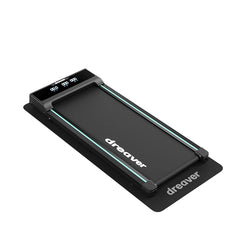
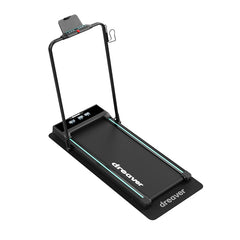
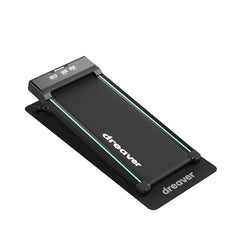
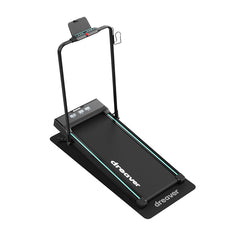
Therefore, first measure the length and width of your treadmill, including any wheels or protruding parts. Compare those measurements with the dimensions of the mat. If you use a compact walking pad under a standing desk, you need a smaller mat than with a treadmill with a bar and a longer running surface.
Thickness
The thickness determines how much cushioning the mat provides. A mat of a few millimeters protects the floor against scratches, but dampens few vibrations. A thicker mat dampens better, but too thick is also not good. On a very soft and thick mat, the treadmill can start to wobble, which feels less stable.
For a treadmill for home use, a mat of about 4 to 6 millimeters thick is usually a good balance between cushioning and firmness. If you live above others and noise is your biggest concern, you can choose slightly thicker, as long as the mat remains firm enough.
Material
Mats for fitness equipment are usually made from one of these materials:
- Rubber: heavy, firm and well-dampening. Rubber stays well in place and is long-lasting. One disadvantage is that new rubber mats can have their own smell for the first few days.
- PVC: light, water-repellent and easy to clean. PVC mats are often rollable and therefore easy to move.
- EVA foam: often used in puzzle mats. Light and soft, but less firm. Under the weight of a treadmill, permanent impressions can form and the loose parts sometimes slide apart.
If you have a vinyl or PVC floor, check if the mat is suitable for that surface. Some types of rubber can cause discoloration on these floors.
Underside and top
A good mat has a non-slip underside, so it does not slide over the floor. The top is preferably slightly textured. This way, the feet of the treadmill stand well and you can step on and off safely, even with socks on.
Maintenance and storage
Choose a mat that you can wipe with a damp cloth. If you store the treadmill after use, a mat that you can roll up or lay flat is convenient. A protective mat that is tailored to the dimensions of a compact treadmill makes that decision a lot easier. You do not have to puzzle with dimensions and thickness yourself.
This is how you lay the mat properly
Laying down a mat seems simple, but with a few small steps you get more out of it.
- Clean the floor. Remove dust, sand and grit. Otherwise, dirt under the mat can still cause scratches.
- Let the mat lie flat for a while. A rolled-up mat sometimes has curled edges. Lay it out for a day in a room with normal room temperature, so that it lies completely flat.
- Determine the spot. Keep about a meter free behind the treadmill, so you can step off safely. Make sure there is an outlet nearby.
- Place the treadmill in the middle. Lift or roll the treadmill onto the mat and check if all the feet are fully on it.
- Check if it stands flat. Press on each corner of the treadmill. If it wobbles, move it slightly or check if the mat is bulging somewhere.
- Tuck the cord away neatly. Do not let the cord run under the mat or the running surface. Lead it along the side to the outlet.
Maintenance of the mat
A mat requires little maintenance, but a little attention keeps it beautiful longer and ensures it continues to do its job.
Regular cleaning
Vacuum the mat and the floor around the treadmill about once a week. Wipe the mat occasionally with a damp cloth and a mild cleaning agent. Do not use aggressive agents, because they can dry out the material.
Also, look under the mat
Lift the mat once a month. This allows you to check that no moisture or dirt has accumulated underneath. Especially with wooden floors, it is wise to prevent moisture from sitting for extended periods.
Watch out for light-induced discoloration
Wooden or lacquered floors gradually discolor under the influence of daylight. The area under the mat therefore remains slightly lighter than the rest of the floor. If you move the treadmill later, you may sometimes see a clear rectangle. If the treadmill is in a sunny room, you can move the mat a few centimeters every now and then to keep this difference smaller.
Replace the mat in time
If you see deep indentations, cracks, or edges that no longer lie flat, the mat will no longer cushion and protect as effectively. That is a good time to replace it.
A mat for a treadmill you store away
Many people choose a treadmill that disappears under the sofa, bed, or a cabinet after use. You can use the mat in two ways.
The first option is to leave the mat in a fixed place, for example under a desk or next to the sofa. You roll the treadmill off after use and put it back on for the next workout. This works well if the mat is not in the way.
The second option is to store the mat together with the treadmill. A thin, rollable mat takes up little space and can be laid down again in a few seconds. However, make sure that the space under your furniture is high enough for the treadmill and the mat together if you want to leave them stacked on top of each other.
If you are still looking for a home treadmill, then include the flooring in your plans right away. Knowing in advance where the treadmill will be placed and what kind of floor is there makes it easier to choose the right combination of treadmill and mat.
A small purchase with a big effect
A mat under the treadmill is barely noticeable, but you will notice the difference every day. Your floor stays intact, the neighbors hear less, the treadmill stands firmly, and the motor has less dust to deal with. These are four benefits that together contribute to a treadmill that you will use for longer and with more enjoyment.
When choosing, look primarily for a size that is large enough, a thickness that combines cushioning and stability, and a material that suits your floor. Lay the mat down carefully and keep it clean. Then the foundation under your treadmill will be just as well taken care of as the machine itself.