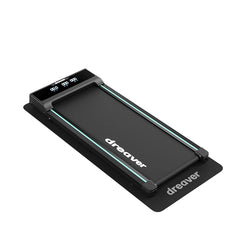
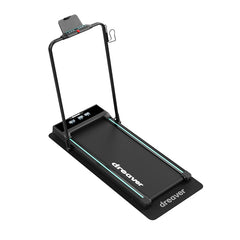
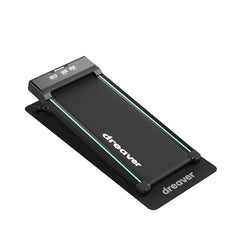
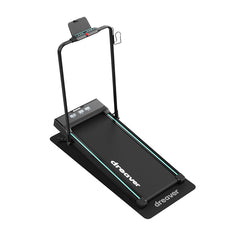
Working out at home is no longer an exception for many people, but has become a regular way to get more exercise into the day. Not because everyone suddenly wants to exercise fanatically, but because walking, power walking, and training increasingly need to fit around work, family, and a busy schedule. A compact treadmill makes that possible. You don't have to go outside first, make time for the gym, or build up a separate routine before getting moving. It is precisely that convenience that makes a home treadmill attractive.
Dreaver vs WalkingPad: what is the difference?
Within this market, Dreaver and WalkingPad are two well-known names. Both brands focus on compact treadmills for home use, but the way they do that clearly differs.
WalkingPad is primarily known for its smart, foldable designs and minimalist approach. Dreaver positions itself more broadly. Not only as a provider of compact treadmills, but as a brand that wants to make exercising at home more comfortable, accessible, and easier to stick with.
You can see that difference not only in the products themselves, but also in everything around them: the Dreaver App, workouts, goals, challenges, community, service, support, and practical extras that help you get started faster and more easily.
The question, therefore, is not only which treadmill looks good on paper, but especially which one better suits how people actually exercise at home in practice.
Two different approaches to exercising at home
Although Dreaver and WalkingPad both fall into the compact treadmill category, they start from a different idea.
WalkingPad places a lot of emphasis on space-saving and smart folding constructions. The brand focuses strongly on people looking for a minimalist device that can be easily stored away. In various models, you can see this in foldable frames and compact designs that take up little space.
Dreaver chooses a different direction. Compactness remains important, but the brand looks beyond just storage. The focus is more on daily use, stability, comfort, motivation, and support. A treadmill should not only fit in your home, but especially in your routine.
That is why Dreaver builds not only products, but also a complete experience around exercising at home. The Dreaver App plays a major role in this, with workouts, walking tours, goals, challenges, and a community that helps users stick with exercise longer.
That difference in starting point is important. With WalkingPad, it is often about smart design and compact storage. With Dreaver, it is more about ease of use, trust, and whether you will still use the treadmill regularly in three or six months.
An initial comparison of the main differences
To make the difference concrete, it helps to put the main features side by side. At the same time, it is important to be honest: WalkingPad has multiple models, which means that features such as speed, rail, incline, and load capacity differ per model.
| Feature | Dreaver | WalkingPad |
|---|---|---|
| Focus | Daily use, comfort, support, and motivation | Compactness and minimalist design |
| Speed | Up to 12 km/h in relevant models | Up to 12 km/h or higher, depending on the model |
| Incline | Automatic incline on selected models | Limited or model-dependent |
| Rail / handrail | Present on relevant models | Present on some models |
| App | Dreaver App with workouts, goals, walking tours, challenges, and community | Basic app functionalities via KS Fit |
| Warranty | 2-year manufacturer warranty | Often 2 years, depending on the retailer |
| Trial period | Try for 30 days | Depending on the purchase channel |
| Trustpilot | 4.6/5 based on over 3,100 reviews | 4.3/5 based on over 750 reviews |
| Support | Highly rated for service and solutions | Mixed experiences |
| Extras | Practical extras such as a mat, cup holder, and e-book with selected promotions | Not included as standard |
What immediately stands out is that Dreaver does not only focus on the treadmill itself, but on the complete picture around exercising at home.
Not only specifications, but also trust
When choosing a treadmill, many people first look at speed, dimensions, and price. That is logical, but ultimately that does not tell the whole story. You don't buy a treadmill only for what it can do technically, but also for the experience around it.
How quickly can you get started? How well will you be helped with questions? What happens if something goes wrong? And does the brand feel reliable enough for a product you want to use several times a week?
It is precisely on that point that Dreaver has a strong position. The high Trustpilot score is supported by thousands of customer reviews. In many reviews, topics such as fast delivery, good communication, thinking along with problems, and a proper solution when something does not go well immediately come up.
WalkingPad also has a good rating on Trustpilot, but Dreaver clearly stands out more when you look at both the score and the number of reviews.
Dreaver currently scores a 4.6 on Trustpilot based on over 3,100 reviews, while WalkingPad scores a 4.3 based on over 750 reviews. That means not only a higher rating, but also a much larger amount of customer feedback on which that score is based.
In addition, it is noticeable that Dreaver actively responds to customer questions and negative reviews. Many reviews mention not only the product itself, but also the service around it: quick responses, thinking along with problems, clear communication, and quick solutions when something breaks.
That is important, because a home treadmill is no small purchase for many people. You want to know that you are not only buying a product, but also that you can fall back on support when you have questions about delivery, use, maintenance, or warranty.
Build quality and stability during use
One of the biggest differences between compact treadmills you often only notice when you actually use them. In product photos, many models look alike, but while walking you immediately feel whether a treadmill is stable and reliable.
WalkingPad clearly opts for a compact and foldable design in many models. That is attractive when you have little space or want to store the treadmill as small as possible after use.
At the same time, a very minimalist design also has limits. The lighter and more compact a model is, the more important it becomes to look closely at stability, load capacity, and support during use.
Dreaver chooses a more global approach in various models. That provides more peace of mind while walking, less doubt at higher speeds, and more confidence when you use the treadmill more often. Especially with models with a rail or automatic incline, that difference becomes relevant.
Not everyone is looking for the smallest treadmill. Some users mainly want certainty, grip, and comfort. From that perspective, it is logical that Dreaver also offers models that provide more support, such as the Assist One. That model was developed for people who want extra stability and a handhold while moving.
With this, Dreaver shows that the brand does not only think in terms of compactness, but also from different user needs.
A substantive comparison in practice
When you put comparable models side by side, you get a better picture of what you are bringing into your home. The Dreaver Elevate Pro is, for example, interesting for people who want to walk, power walk, and train at home with extra intensity through automatic incline.
| Specification | Dreaver Elevate Pro | WalkingPad comparable model |
|---|---|---|
| Top speed | Up to 12 km/h | Up to 12 km/h or higher, depending on the model |
| Incline | Automatically adjustable up to 10% | Present on some models |
| Rail | Yes | Depending on the model |
| Load capacity | Up to 135 kg | Depending on the model |
| Compactness | Compact and suitable for home use | Strong in foldable design |
| Operation | Via device, remote control, and Dreaver App | Via display and remote control |
| Phone / tablet use | Practical holder in relevant models | Present on some models |
| Extras | Regularly delivered with practical extras | Depending on the model and retailer |
What stands out here above all is that Dreaver is strong in the total picture. The Elevate Pro combines speed, automatic incline, a rail, app support, and practical extras. Because of this, the model feels less like a smart gadget and more like a treadmill with which you can really build a routine.
WalkingPad remains strong when compactness and foldability are the most important criteria. Dreaver becomes especially interesting when you also value stability, guidance, service, and convenience during daily use.
Automatic incline as a practical advantage
An important difference between Dreaver and many compact walking pads is the incline.
With the Dreaver Elevate Pro, you can automatically set the incline up to 10%. That makes it easier to alternate your training and increase the intensity without having to walk harder.
That is especially useful for people who want to get more out of their walking moment at home. An incline provides more intensity, while the movement remains low-threshold.
The advantage of Dreaver is mainly in the automatic operation. You can switch more easily while walking without interrupting your training. In combination with the Dreaver App and remote control, that provides more control and a more natural training flow.
The Dreaver App as a difference in daily use
One of the biggest differences in this comparison is the way Dreaver uses the app.
Where many brands use an app primarily as a technical addition to the product, Dreaver positions the app much more explicitly as part of the total experience around exercising at home.
The Dreaver App helps users not only with operation, but especially with motivation and routine. Think of workouts, goals, walking tours, challenges, and an active community in which users motivate each other.
Because of this, it does not stop at just "buying a treadmill". The focus is much more on actually sticking with exercise in the long term.
That makes it easier to:
- start training with a focus
- keep track of goals
- create variety with walking tours
- stay motivated via challenges
- make exercise part of your routine
Precisely that fits well with the broader positioning of Dreaver: not only sell a treadmill, but make exercising at home easier to stick with.

Ease of use and immediate usability
Ordering a treadmill for home often wins or loses on one simple point: how easy is it to get started?
People rarely stop because they don't want to exercise. They stop because the threshold becomes too high. Too many steps, unclear settings, or cumbersome operation quickly cause a device to be used less than hoped.
Dreaver scores strongly here because the brand focuses on immediate usability. Many models are designed according to a Plug & Play principle: put it down, connect it, and start.
Also during use, that remains important. With Dreaver, you can easily switch via the remote control, operation on the device, and the Dreaver App. With models with automatic incline, you can adjust the intensity without interrupting your session.
That makes ease of use concrete:
- start quickly without complicated installation
- simple operation with remote control
- automatic incline on selected models
- extra guidance via the Dreaver App
- goals, workouts, and challenges immediately available
- practical holder for phone or tablet
Precisely that combination ensures that exercising feels less like a separate task. You can walk during work, a series, a call, or a quiet moment of the day.
WalkingPad is also user-friendly, especially through the compact design and the simple operation. Dreaver only places more emphasis on the complete flow: from starting to sticking with it.
Compactness: WalkingPad strong, Dreaver more broadly applicable
WalkingPad has rightly built a strong name around compactness. The brand became known with smart, foldable designs that take up little space.
That is a clear advantage for people who are mainly looking for as compact a device as possible.
At the same time, compactness is not the most important criterion for everyone. A treadmill should not only be small when you store it, but also feel pleasant, stable, and safe when you use it.
Dreaver therefore opts for a broader approach. The treadmills are still suitable for home use and practical to store, but the brand also looks at stability, comfort, and support. With some models, that means deliberately a bit more construction or a rail, because this gives more confidence during walking.
That is especially relevant for users who train more often, use higher speeds, or seek extra certainty. And for people who need even more support, Dreaver with the Assist One offers a model that revolves less around ultra-compact storage and more around safe and comfortable movement.
With this, the difference is clear:
WalkingPad is strong in maximally compact design.
Dreaver is strong in practical daily use, with more attention to stability, guidance, and trust.
Free extras make the difference bigger
A comparison on price is only fair when you look at what you actually get.
With compact treadmills, a model sometimes seems cheaper, but accessories are not included as standard.
Dreaver regularly adds extra value here with accessories such as a treadmill protection mat, cup holder, and e-book. Those are practical additions that make use immediately easier.
In combination with the Dreaver App, this creates a more complete start. You get not only a device, but also more support to actually do something with it.
With WalkingPad, this depends more strongly on the model, the package, and the retailer. That is why it is important to look closely at what is included as standard during a price comparison.
Service and support as a decisive advantage
With this kind of product, service is sometimes only considered important when a problem arises. In reality, it is an important part of the entire purchase.
A home treadmill should not only work well, but also be supported by a brand that is accessible and takes responsibility when necessary.
Dreaver scores strongly here. The combination of a 4.6 Trustpilot score, thousands of reviews, and many positive experiences around customer service gives confidence.

Many reviews mention:
- quick responses
- clear communication
- thinking along with problems
- efficient handling of returns
- quick solutions when something breaks
That provides peace of mind both at the time of purchase and during use.
WalkingPad also scores well on Trustpilot, but Dreaver comes out stronger based on review volume, service experiences, and a visible focus on after-sales support.
Which treadmill is best suited to your situation?
WalkingPad remains an interesting choice for people who value maximum compactness and a minimalist design.
Dreaver comes out stronger when you look at the big picture. The combination of stability, ease of use, automatic incline on selected models, a rail on relevant models, practical accessories, the Dreaver App, community, strong support, and a 30-day trial period makes the brand more complete for many home users.
That does not mean that WalkingPad does not have good products. It mainly means that Dreaver is better suited to people who not only want to try exercising at home, but really want to stick with it.
Conclusion: Dreaver feels more complete for daily use
Dreaver and WalkingPad serve the same market, but do so from a different angle.
WalkingPad excels in smart, compact, and foldable treadmills. For people who are primarily looking to save space, that is attractive.
Dreaver builds a broader overall package around that. The treadmills are suitable for home use, but also offer more support around daily use. Think of stability, automatic incline, the Dreaver App, workouts, goals, challenges, community, practical extras, strong reviews, and clear service.
That is exactly what makes the difference.
A treadmill should not only look good when you buy it. It must be pleasant enough to use again and again. Dreaver focuses precisely on that point: fewer barriers, more confidence, and more support to keep exercising at home.