Buying a treadmill is a purchase you want to make good use of for years. Yet the range is vast and many models look similar at first glance. Product pages are full of figures about speed, power and weight capacity, but what do they mean for your daily use? In this article you will learn what types of treadmills are available, how to read specifications, what budget is realistic and what conditions to look out for before you order. With a simple step-by-step guide at the end, you will make a choice that suits your home, your goals and your way of moving.
Start with your own situation
Many people start their search with the models themselves. They quickly compare speeds, look at prices and read reviews. That is understandable, but it often makes the choice harder than necessary. Without a clear idea of what you are looking for, every model seems to have something good about it.
It helps to first answer a few questions for yourself:
- What do you mainly want to do: walk at a leisurely pace, train vigorously, jog or walk on an incline?
- When will you use the treadmill: during work, in the evening in front of the TV or as regular exercise?
- Who else will be walking on it, and how do these people differ in height, weight and fitness?
- Where will the treadmill stand during use, and where will it go afterwards?
- Do you need support or extra stability while walking?
With these answers, a large part of the range can already be ruled out. That is exactly the intention. You are not looking for the treadmill with the most features, but the treadmill that best suits how you are going to use it.
The four types of treadmills for home use
Treadmills for home use can be roughly divided into four groups. Each group has its own purpose, and the differences are greater than they seem at first glance.
The flat walking pad
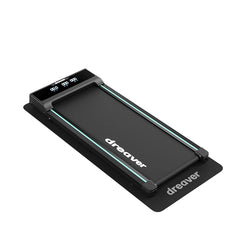
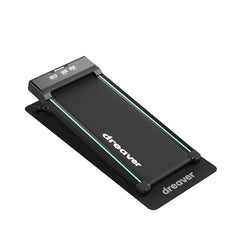
A walking pad, also known as a walking pad, is low, compact and usually without a fixed handle. It is designed for leisurely walking, for example under a standing desk or while watching a series. The top speed is often around 6 kilometres per hour.
This type is well suited to people who mainly want to get more steps in on an ordinary day. Thanks to the flat design, you can slide it under the sofa or bed after use. If you want to jog or train intensively, a walking pad will usually fall short.
The treadmill with a handle for walking and jogging
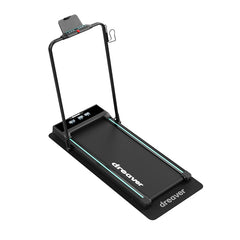
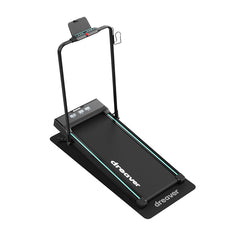
A treadmill with a folding handle offers more possibilities. The top speed is higher, often around 10 to 12 kilometres per hour. This means that in addition to walking, you can also jog or do interval training. The handle provides support when getting on and off and at a higher pace.
A model like the Dreaver Motion Pro falls into this group, with a speed range of 1 to 12 kilometres per hour. Such a treadmill grows with you: you start by walking and gradually build up to a more vigorous workout.
The treadmill with an incline
On a treadmill with an incline, the running surface can tilt upwards. This makes walking much more intense without having to run. Your heart, lungs and leg muscles work harder, while the impact load on your joints remains limited.
There are models with a manual and an automatic incline. With an automatic incline, you change the setting while walking, with a button or via an app. This is convenient if you want to work with intervals. A model like the Dreaver Climb goes up to an incline of 12 per cent, which already feels like a vigorous walk uphill.
The treadmill with extra support
Not everyone walks with the same level of confidence. For older people, people recovering from an injury or people with less balance, safety plays a bigger role than speed. For them, there are treadmills with a low step-through, a leisurely starting speed and sturdy side rails to hold on to.
The Dreaver Assist One is an example of this. This model is available with or without a side rail and has a speed of 1 to 10 kilometres per hour. This way you can start at a leisurely pace and still keep moving if you need a little more confidence.
Reading specifications without getting lost
Anyone comparing different treadmills will quickly come across a list of technical data. Not every figure is equally important. Below you will read which specifications say the most about your daily use.
Speed range
The speed range indicates how slowly and how fast the belt can run. For walking during work, 1 to 6 kilometres per hour is more than enough. If you also want to jog, look for a top speed of at least 10 kilometres per hour. Also pay attention to the lowest speed. A belt that can start very slowly is convenient for beginners and for those who want to build up carefully.
Motor power
Manufacturers sometimes refer to the power as peak power and sometimes as continuous power. Peak power is what the motor can deliver briefly, continuous power is what it can handle for a long time. The second figure says the most about how the treadmill performs during a long walk or workout. A motor with sufficient power continues to run evenly and heats up less quickly.
Running surface dimensions
The running surface is the part of the belt that you walk on. For walking, a width of around 40 centimetres and a length of 100 to 120 centimetres is usually comfortable. If you are tall or want to jog, a slightly longer running surface is more convenient, because your steps are then larger.
Maximum weight capacity
Every treadmill has a maximum weight that it can safely carry. Choose a model where your weight remains well below that maximum. Then the motor works comfortably and parts wear out less quickly. If multiple people use the treadmill, base it on the heaviest user.
Height and weight of the treadmill
If you want to store the treadmill after use, the height and weight are just as important as the speed. Measure the free space under your sofa or bed at its lowest point. Also check if the treadmill has wheels, so you can easily roll it away.
Noise
Some manufacturers provide a noise level in decibels. That figure is useful for comparing models, but does not tell the whole story. In practice, you also hear the sound of your footsteps and the vibrations that travel through the floor. Reviews from other users often give a more realistic picture of how quiet a treadmill really is in a home.
In short, a comparison looks like this:
|
Specification |
What it tells you |
What to look out for |
|---|---|---|
|
Speed range |
What workouts are possible |
Up to 6 km per hour for walking, 10 or higher for jogging |
|
Continuous power |
How the motor performs during prolonged use |
Continuous power is preferable to peak power alone |
|
Running surface |
How much space you have per step |
A longer running surface for jogging or a greater length |
|
Weight capacity |
How much load the treadmill can handle |
A generous margin above your own weight |
|
Height and weight |
How easily you can store it |
Measuring under furniture, wheels at the front |
|
Incline |
How intensively you can walk |
Manual or automatic, and up to what percentage |
What budget is realistic?
The prices of treadmills for home use vary widely. A higher price does not automatically mean a better choice for you. It is about what you get for your money, and whether that suits how you are going to use the treadmill.
What you can generally expect per price class
In the lower price class you will mainly find simple walking pads. These are suitable for leisurely walking, but often have a limited speed range and a simpler motor. In the mid-range you usually get a higher top speed, a handle, better cushioning and sometimes an app. With the more expensive models, features such as an automatic incline, a stronger motor or extra support are added.
A practical approach is to first determine which features you are really going to use. Pay for what you need, with a little room to grow. An incline you never use is money you could have spent elsewhere. Conversely, a treadmill that already feels too limited after a few months is also not a good investment.
Think about additional costs
In addition to the treadmill itself, there are a few things you can include in your budget:
- A mat for under the treadmill, to protect your floor and dampen noise.
- Silicone oil to regularly lubricate the belt.
- Possibly a standing desk, if you want to walk during work.
- Good indoor shoes with cushioning, if you walk a lot and for a long time.
These costs are usually limited, but it is good to take them into account beforehand. That way you will not be faced with surprises once the treadmill is inside.
Buying online or in a store
More and more people buy their treadmill online. This has advantages: the range is larger, you can compare at your own pace from home and you can read the experiences of other buyers. The disadvantage is that you cannot try out the treadmill first.
In a store you can stand on a treadmill for a moment, but that says less than you might think. Walking for a few minutes in a showroom is different from walking every day in your own living room. How does the treadmill sound on your floor? Does it really fit under your desk? Do you actually use it as often as you thought? You will only find out at home.
That is why a trial period when buying online is so valuable. With a period during which you can test the treadmill at home and return it if necessary, you remove the greatest uncertainty. So when comparing, look not only at the treadmill, but also at the seller's terms.
Terms you check beforehand
A treadmill is a device with a motor and moving parts. No matter how well it is made, something can always go wrong. That is why it pays to look beforehand at what is covered.
Warranty
How long is the warranty, and what exactly does it cover? Some manufacturers offer a different warranty on the motor than on the rest of the treadmill. A two-year manufacturer's warranty is a common starting point for home treadmills.
Trial period and returns
Can you try out the treadmill at home? How long do you have for that, and how do returns work? A treadmill is large and heavy, so it is convenient if the seller arranges the collection.
Customer service and parts
Read how other customers experience the service. Is customer service easy to reach and do they respond quickly? Can separate parts, such as a remote control or a new belt, be ordered later? This also determines how long you will enjoy your treadmill.
Delivery and installation
Is the treadmill delivered to the door, or also inside? Do you have to assemble it yourself? Many compact treadmills are almost ready to use upon delivery, but it is good to know that beforehand. Clear instructions make a difference.
Common mistakes when buying a treadmill
A few mistakes occur so often that they are worth mentioning. Those who know them avoid most disappointments.
Not measuring
The most common complaint after purchase is that the treadmill does not fit in the place one had in mind. Too long for the space, just too high for under the sofa or a desk that is no longer at the right height. Therefore, always measure beforehand, both the place of use and the storage place.
Buying for the ideal image
Many people buy a treadmill for the athlete they want to become. A heavy machine with many functions, while in reality they mainly want to walk leisurely. It is better to choose based on how you move now, with room to expand a little.
Choosing only on price
The cheapest treadmill seems attractive, but a too weak motor or poor cushioning you will quickly notice with daily use. Conversely, the most expensive treadmill is not always the best choice. Look at the ratio between price, functions and terms.
Forgetting who else uses it
A treadmill is often used by several people in the household. A partner who wants to jog or a heavier family member has different requirements. Take that into account beforehand.
Skipping reviews
Product descriptions mainly show the strong points. Experiences of other users tell you how a treadmill behaves after a few months. Pay particular attention to recurring points, both positive and negative.
A practical step-by-step plan
With the steps below you narrow down your choice to a few suitable models.
- Determine your goal: walking, jogging, walking on an incline or moving safely with support.
- Measure the place where you walk and the place where the treadmill stays after use. Keep about a meter free behind the treadmill.
- Choose the type of treadmill that suits your goal and your space.
- Within that type, compare the most important specifications: speed, power, running surface, weight capacity and height.
- Set a budget, including small extras such as a mat and oil.
- Read experiences of other users about noise, sturdiness and ease of use.
- Check the terms: warranty, trial period, returns and customer service.
- Make your choice and test the treadmill at home in your own daily routine.
Those who follow these steps can compare the range of treadmills with peace of mind. In an overview where you can buy a treadmill you then place the models side by side, on the points that weigh heaviest for you.
A choice that suits your daily life
A good treadmill is not the treadmill with the highest top speed or the longest list of functions. It is the model that so naturally fits into your home and your day, that you step on it without thinking. That is why a good choice starts with your own situation: what you want to achieve, how much space you have and how you prefer to move.
Take the time to measure, compare and read the terms. Then you choose a treadmill that does not stand in the corner after a few weeks, but remains a permanent part of your routine for years.