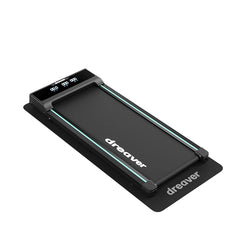
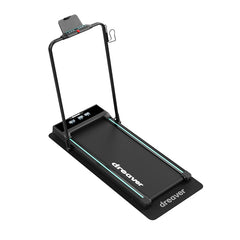
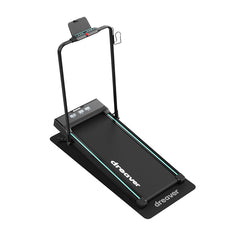
In short: For most people, a good speed on a walking pad to get 5,000 steps daily is between 3 and 5 km/h. How long you need to walk depends on your height and stride length. On average, expect to walk for 45 to 60 minutes, spread throughout the day. Five thousand steps a day. It sounds like an achievable goal, but if you spend most of your time at a desk, it often proves difficult in practice. A walking pad is a great solution: you can simply walk at home while you work, watch a series, or attend a meeting. But then the question arises: what speed should you set the machine to? Too slow and you won't reach your step goal within a reasonable amount of time. Too fast and walking while working becomes difficult or even unsafe. The right speed depends on who you are, what you want to achieve, and how you distribute your walking throughout the day. In this article, we explain step by step which speed works best for 5,000 steps a day on a walking pad. You'll learn how height, fitness, and goals affect the calculation, and you'll get a practical walking routine that helps you effortlessly reach your daily step goal.
How many steps do you take per hour on a walking pad?
Before you set the speed, it's useful to know how many steps you take per hour at different paces. This varies from person to person, but there are good rules of thumb. The average stride length of an adult is between 70 and 80 centimeters. Based on that, the following is a rough guide:
- 2.5 km/h (leisurely pace): approximately 3,000 to 3,500 steps per hour
- 3.5 km/h (normal pace): approximately 4,500 to 5,000 steps per hour
- 5 km/h (brisk pace): approximately 6,000 to 7,000 steps per hour
If you want to get exactly 5,000 steps a day, a speed of 3.5 km/h will get you close. This is a relaxed and steady walking pace that most people can maintain without difficulty, even while working.
Why does the right speed vary from person to person?
Two people can walk at exactly the same speed and still take a very different number of steps per hour. This is due to several factors:
Height and stride length
Taller people have a longer stride, meaning they cover more meters per step. As a result, they take fewer steps per kilometer than shorter people. Someone who is 1.90 meters tall takes significantly fewer steps at 4 km/h than someone who is 1.60 meters tall at the same speed.
Walking style
The way you walk affects your stride length. Someone who takes wide steps covers more meters per step than someone who takes small, quick steps.
Fitness and familiarity
Those who are just starting out on a walking pad often automatically walk more cautiously and with a shorter stride. As you become more accustomed to the machine, your walking pattern becomes more natural and your stride length increases.
Training goal
Are you walking purely to get more exercise, or are you deliberately using the walking pad as a training tool? When training actively, you walk briskly and take more steps per minute. Walking while working requires a slower pace where your hands are free and your concentration is not disrupted.
Which speed is right for your situation?
There is no universal answer, but there are clear guidelines based on usage.
Walking while working: 2.5 to 3.5 km/h
This is the most common scenario for a walking pad. You walk during meetings, while answering emails, or during other light tasks. At this speed, you can type, talk, and think without any problems. At 3 km/h, you walk an average of 3,500 to 4,000 steps per hour. You will therefore need to walk actively for an hour to an hour and a half to reach 5,000 steps. That may sound like a lot, but spread throughout the workday, it is quite manageable.
Deliberate walking as exercise: 4 to 5 km/h
If you are not using the walking pad alongside work, but specifically as a time to exercise, you can walk briskly. At 5 km/h, you will reach 5,000 steps in about 45 minutes, depending on your stride length. This pace feels like a brisk walk outdoors. It requires a bit more attention to your body, but it works well if you want to achieve your daily exercise goal quickly.
Beginners: start at 2 km/h
Are you not yet accustomed to a walking pad? Then start slow. Two kilometers per hour may feel slow, but it gives you time to get used to walking on a treadmill. Gradually increase the speed over the first few weeks.
How long do you need to walk for 5,000 steps?
Based on an average stride length of 75 centimeters, you need slightly more than 3.7 kilometers for 5,000 steps. How long that takes depends on your speed:
- Speed 2.5 km/h: approximately 89 minutes
- Speed 3.0 km/h: approximately 74 minutes
- Speed 3.5 km/h: approximately 63 minutes
- Speed 4.0 km/h: approximately 55 minutes
- Speed 5.0 km/h: approximately 44 minutes
These times are estimates. If you have a longer stride length, you will finish sooner. If you have a shorter stride length, it will take a little longer.
Practical walking routine: how to distribute 5,000 steps throughout the day
The great advantage of having a walking pad at home is that you do not need to take all the steps in one session. Spreading them out is actually good, both for your body and your productivity. Here is an example of a daily schedule that helps you effortlessly reach 5,000 steps:
- Morning (20 minutes at 3.5 km/h): start your workday actively. Walk while going through your emails or during your first morning meeting. This way, you can quickly get 1,500 steps before the real work begins.
- Afternoon (30 minutes at 3 km/h): after lunch, your energy level is often a bit lower. A relaxed walking session keeps you awake and alert. In half an hour, you can take another 1,500 to 2,000 steps.
- Late afternoon (20 minutes at 4 km/h): end the workday actively. Walk briskly during a phone call or final meeting. This will earn you another 1,500 steps.
Total: over 4,500 to 5,000 steps, without needing a separate workout session.
Walking while working versus deliberate walking: what is the difference?
These are two very different ways to use a walking pad, and both have their value. Walking while working is about breaking up periods of sitting. You are not exercising; you are working. The walking pad keeps your body moving while your mind stays focused on your tasks. The speed must be slow enough to do everything properly, such as typing, talking, and thinking. This makes a treadmill for home a practical way to incorporate more exercise into your workday routine.
Deliberate walking as a workout has a different goal. You step away from your work for a while, set the speed a little higher, and walk mindfully. This increases your heart rate, can improve your fitness, and gives your mind space to recover from mental exertion. Even a 20-minute session at 4.5 km/h can provide health benefits.
A combination of both is a good approach: use the walking pad during the day as a work tool at a low speed, and schedule one or two deliberate walking sessions at a higher pace. Regular use also requires proper maintenance. Therefore, regularly check whether the treadmill belt needs lubrication and use suitable treadmill oil.
Start small, but start today
5,000 steps a day is a realistic and achievable goal for many people, especially with a walking pad at home. For most people, the right speed is between 3 and 4 km/h, depending on your height, walking style, and whether you are working at the same time. You do not need to walk for an hour straight right away. Distribute your steps throughout the day, combine relaxed work sessions with a brisk walk, and gradually build up the pace. Your body will quickly get used to it, and before you know it, 5,000 steps a day will be the norm instead of the exception.