The best times to walk during your workday are just before a focus block, during listening meetings, and after lunch. Walking before a focus block sharpens your concentration, during listening meetings you make use of 'dead' time, and an afternoon slump disappears faster when you move. The secret is not in wanting to walk more, but in establishing set times that become second nature. A walking pad under your desk is easy to buy. The difficult part comes after: when do you actually get on it without your work suffering? Many people walk enthusiastically for three hours a day the first week and never again. That is not due to motivation, but to timing. Walking at the wrong time feels like fighting against your own workday. In this article, you will learn how your energy and concentration behave throughout the day, which times are best suited for walking, and how to build a routine that becomes automatic. Including two ready-made sample schedules: one for the morning person and one for those who get going in the afternoon.
How do energy and concentration behave during a workday?
Your energy is not a flat line. Most people experience a strong focus peak in the morning, a noticeable slump shortly after lunch, and a second, milder peak in the late afternoon. Researchers call this pattern the circadian rhythm, and it can largely determine when you are sharp and when you slump.
This is important for walking during work. Not every moment calls for the same type of movement. During a focus peak, you do not want to scatter your attention. During a slump, a little movement is exactly what you need to wake up. Those who align their walking times with these natural waves need to use far less willpower.
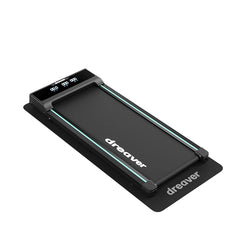
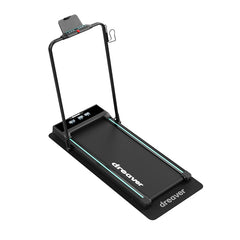
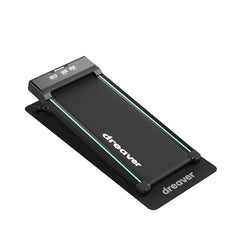
A compact treadmill in your office makes this practically feasible. You step on it during the afternoon slump, walk for ten to fifteen minutes at a relaxed pace, and step off when you start your next task. No changing clothes, no travel time, no barriers. Place a treadmill protection mat underneath for a stable and quiet setup, so you can move undisturbed even during a call or meeting.
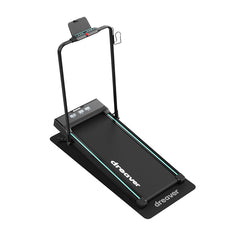
There is another benefit. Light movement can increase your heart rate just enough to bring more oxygen to your brain. This can make you feel more alert without breaking a sweat or getting out of breath. A walking pad at a relaxed pace (around 3 to 4 km/h) is ideal for this: you move, but you can still type, read, and talk. The Dreaver Motion Pro is a suitable choice for this: it runs quietly, has a range of 1 to 12 km/h, and thus fits perfectly into that relaxed work pace.
When is the best time to walk during work?
Three times stand out. They work for almost everyone, regardless of role or working hours.
Just before a focus block
A short walk before you start deep work acts as a start button. Movement can stimulate blood flow and help you organize your thoughts. When you sit down for a focus block afterward, you are already in the right mode.
Ten to fifteen minutes is enough. Do not walk during the focus block itself if your work requires a lot of precision or thinking, because typing at speed and complex thinking tasks do not go as well together with walking. Use the walk as a warm-up instead.
During listening meetings
This is probably where the greatest hidden walking gain lies. Meetings in which you mainly listen (updates, presentations, brainstorms where you do not need to type constantly) are perfect to spend on the walking pad. You miss nothing, your camera can be on, and you effortlessly collect steps.
A workday with two or three listening meetings can thus quickly yield 5,000 to 8,000 steps. Time you were already losing suddenly becomes exercise time.
After lunch
The notorious afternoon slump is the ideal walking time. Instead of dragging yourself through a sluggish hour, step onto the walking pad for twenty minutes at a relaxed pace. The movement can aid your digestion, increase your alertness, and prevent you from nodding off in front of your screen.
Consciously plan lighter tasks after lunch: answering emails, reading documents, processing short messages. That kind of work combines perfectly with walking, especially at the moment when heavy thinking is difficult anyway.
How do you build a walking routine that becomes automatic?
The difference between a walking pad that gathers dust and one you use daily lies in habit formation. You want to have to decide anew every day as little as possible.
Link walking to something you already do. This is simply called habit stacking. For example: every listening meeting automatically means the walking pad. Or: after lunch, you always walk through your emails. By attaching the movement to a set time, the choice disappears.
Start small. Two walking times per day of twenty minutes is more sustainable than an ambitious hour that you give up after three days. You can always expand as soon as the routine is established.
Make it visible and accessible. A walking pad that lies ready under your desk is used more often than one you have to take out of the closet every time. The fewer barriers, the greater the chance that you keep walking. The Dreaver Assist One also offers extra stability, handy if you still need to get used to combining walking and working.
Keep track, but not obsessively. A simple step counter or a mark on your calendar gives a pleasant sense of progress. It is about consistency over weeks, not perfect days.
Sample schedule for a morning worker
Are you sharp in the morning and slump in the afternoon? Then start your heavy thinking early and use the walking pad to keep the afternoon lively.
- 08:30 – Short 10-minute walk as a warm-up, before you log in
- 08:45 – 11:00 – Seated focus block: your most important, most complex work
- 11:00 – Listening meeting on the walking pad (20–30 min)
- 12:30 – Lunch
- 13:00 – 20-minute walk while you go through your emails and messages
- 14:00 – 16:00 – Mix of seated work and short walking moments during consultations
- 16:00 – Concluding 10-minute walk to let go of the day
In total, you effortlessly reach about 60 minutes of exercise, spread over the day.
Sample schedule for an afternoon worker
Do you only really get going after lunch? Then use the morning to start slowly with light movement, and save your seated focus for your natural peak in the afternoon.
- 09:00 – 20-minute walk while you plan your day and read emails
- 09:30 – Listening meeting on the walking pad (20–30 min)
- 10:30 – 12:00 – Lighter tasks, alternated with standing or walking
- 12:30 – Lunch
- 13:00 – Short 10-minute walk as a warm-up towards your focus peak
- 13:30 – 16:00 – Seated focus block: your best thinking at your strongest moment
- 16:00 – Listening meeting or administrative tasks on the walking pad
Here too you effortlessly collect an hour of exercise, perfectly aligned with when your head works hardest.
Start with the moments that are already there
You do not need to overhaul your workday to move more. The gain lies in the moments that are already there: the warm-up to a focus block, the meeting in which you mainly listen, the sluggish hour after lunch. Align your walking times with your natural energy, link them to set habits, and walking becomes second nature.
Start this week with one set walking time. Choose the moment that feels easiest (often the first listening meeting) and build from there. Within a few weeks you will notice that moving is no longer an extra task, but simply part of how you work.
Want to discover how a Dreaver walking pad fits quietly under your desk and moves along with the rhythm you already have? Then take a look at how others have woven it into their workday.